THE ASK
The objective of this project was to tap into our critical thinking skills and predict what the "zeitgeist" or the "spirit of the times" would be in the next 2 to 5 years. How would people think? How would they act? What would be consumer behaviors? How would people dress? What would be the normal way of life? These are just a few questions our group asked ourselves to reach our prediction.
Segment Analysis
THE Team
Delana Irby
irbydc@vcu.eduAlyssa Carman
carmanal@vcu.eduGraphic Design

Marie Berrong
berrongnm@vcu.eduMadison Perkins
perkinsmr@vcu.eduResearch
Market Literacy
The Process
-
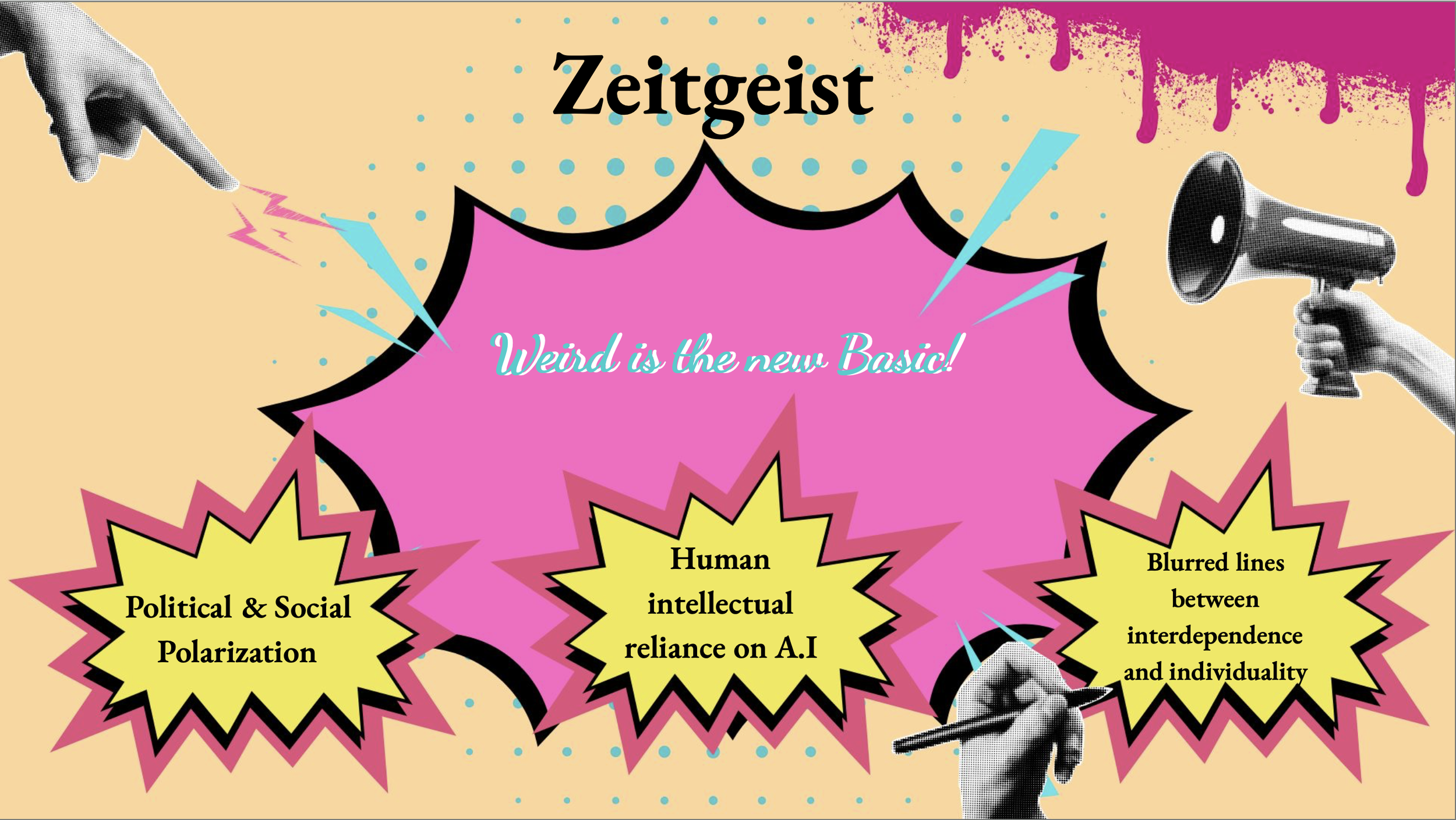
As my team and I were contemplating our topic, the main conclusion we kept coming to was: “ It’s so much going on!” That’s when it hit. Because so much is going on, weird has become the new basic. Our zeitgeist is a reflection of the behavioral patterns that have been shown throughout this whole year because of the mass overstimulation of world events. From political & Social Polarization, Human intellectual reliance on A.I., and the blurred lines between interdependence and individualism, society has lost the meaning of authenticity, Natural Authenticity if we’re being specific.
-
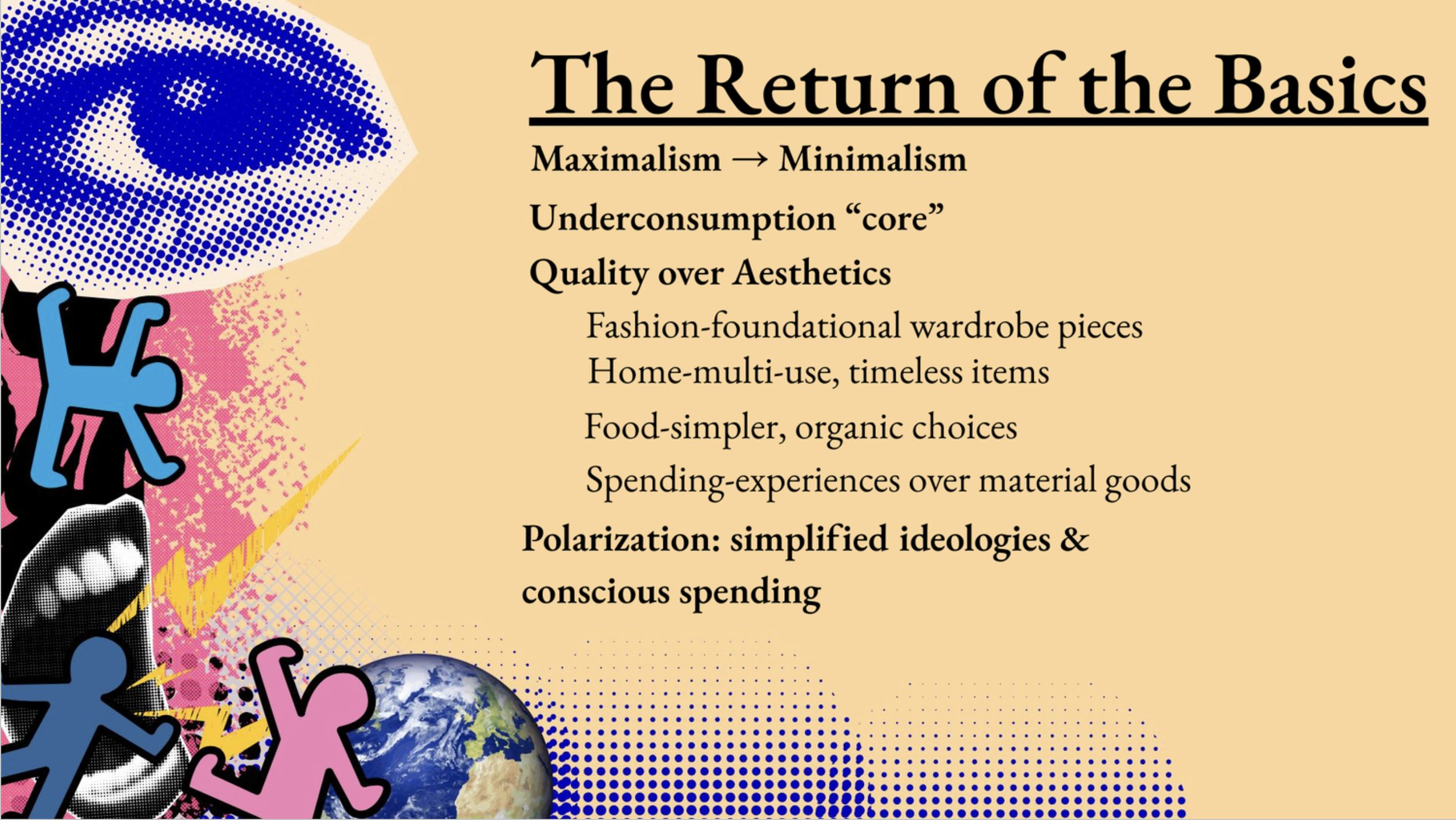
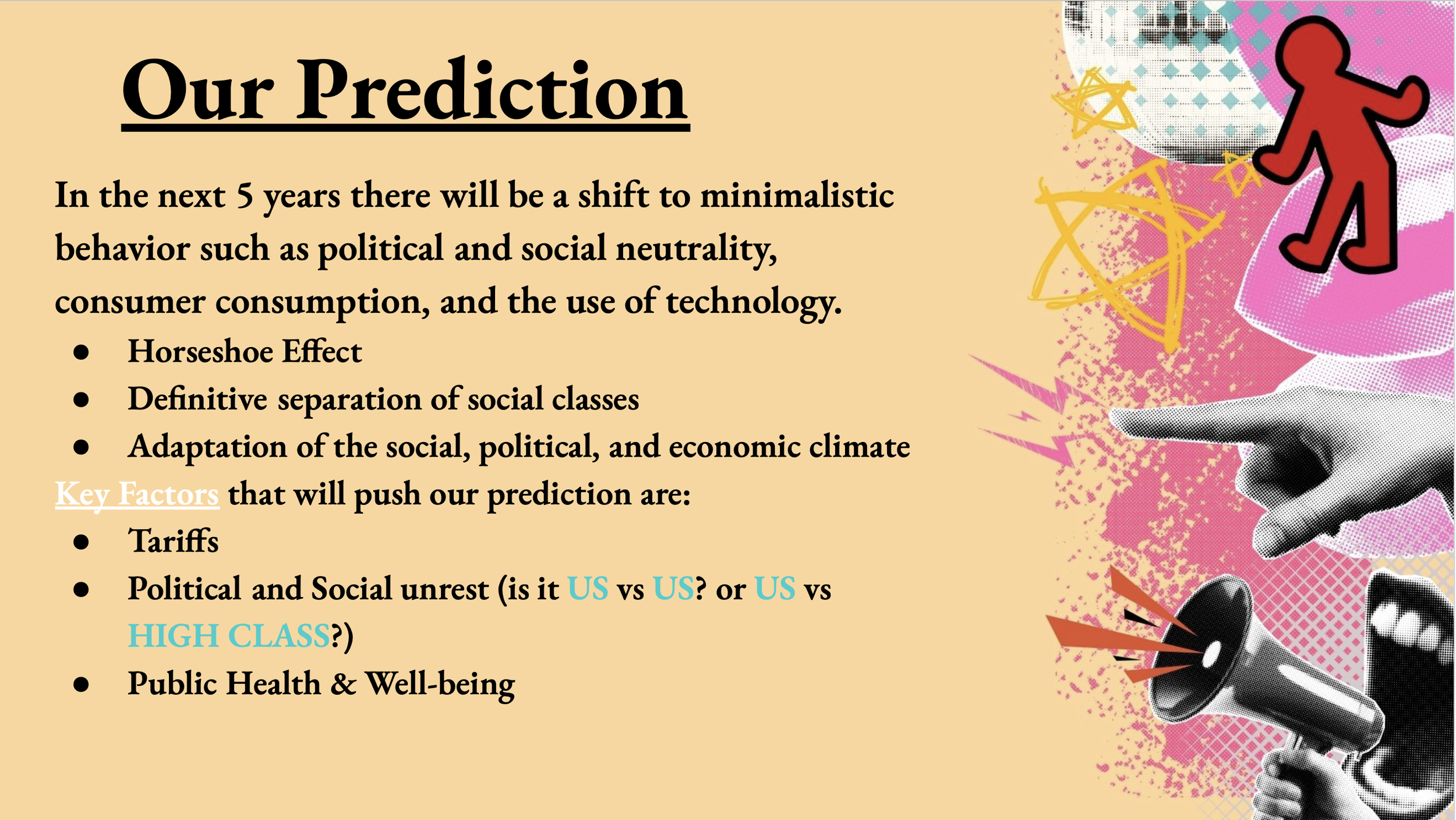
Our zeitgeist has led us to the conclusion that in the next five years, we predict a shift toward minimalism across politics, social behavior, consumer habits, and technology.
As overstimulation grows, people try to stand out, yet often mirror each other. This reflects the “horseshoe effect,” where extremes start to look alike.
We see this in class behavior too: the wealthy once showed status through excess, but now lean toward brand-less fashion and minimalist spaces—distinguishing themselves as overconsumption becomes mainstream.
Overall, minimalism will rise as a response to political unrest, economic pressures, and public health concerns. So, as we continue on with this presentation, I want you all to keep this question in mind: Has individuality stayed true as a natural result of human nature, or has it become “synthetic”?
-
With the uncertainty of times, many people or creatives have begun to push out so many ideas or trends, that the future just seems like a blank sheet of paper. As we approach 2030, we’ll see minimalism grow in everyday life. People are moving away from overstimulation and trend fatigue, choosing simplicity instead. Economic pressures and political polarization will push consumers to value durability and authenticity. Rather than chasing fast trends, they’ll invest in products that truly last. Ultimately, the cultural shift will redefine success—not by how much we own, but by how intentional and meaningful our choices are. In the future, less really does become more.
-
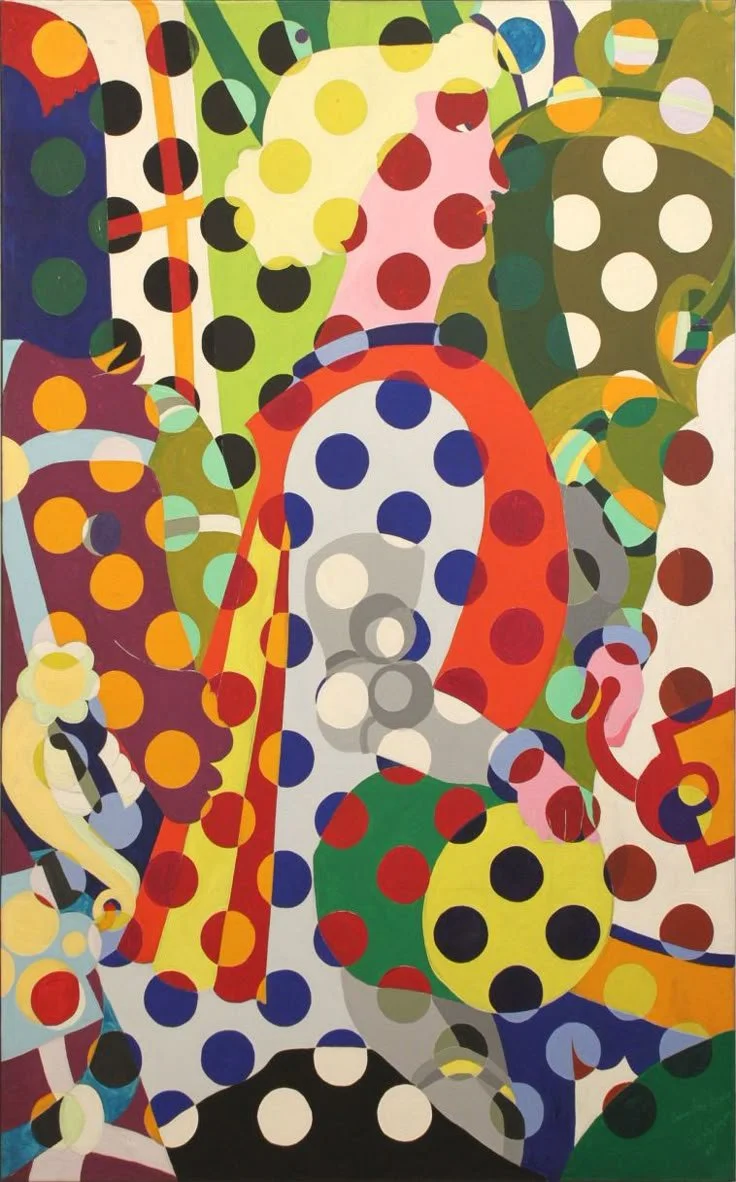
For our individual tasks in the group, I volunteered to create the slide deck. When we were brainstorming our prediction, we already knew that the main idea behind our prediction was going to be about idividualism and gloabal spontaneity. I wanted our slide deck to have pops of color to represent spontaneity. As we finalized our prediciton to Identity in a hyper-connected, polorized world, I added more design elements that relate to pop art since that was an art movement that represented the shift of society acknowledging mass media and pop culture.
Collaborative skills
Project MANAGEMENT
Nicole Leonidov
leonidovnm@vcu.eduSkills
The Outcome
The outcome of the project was highly SUCCESSFUL because of all the work and effort that the team and I put in. Our presentation was graded HIGHLY, and our professor's feedback was positive. Our research and analysis led to the prediction, and my prior digital design experience helped shape this presentation.
The Cultural Research Project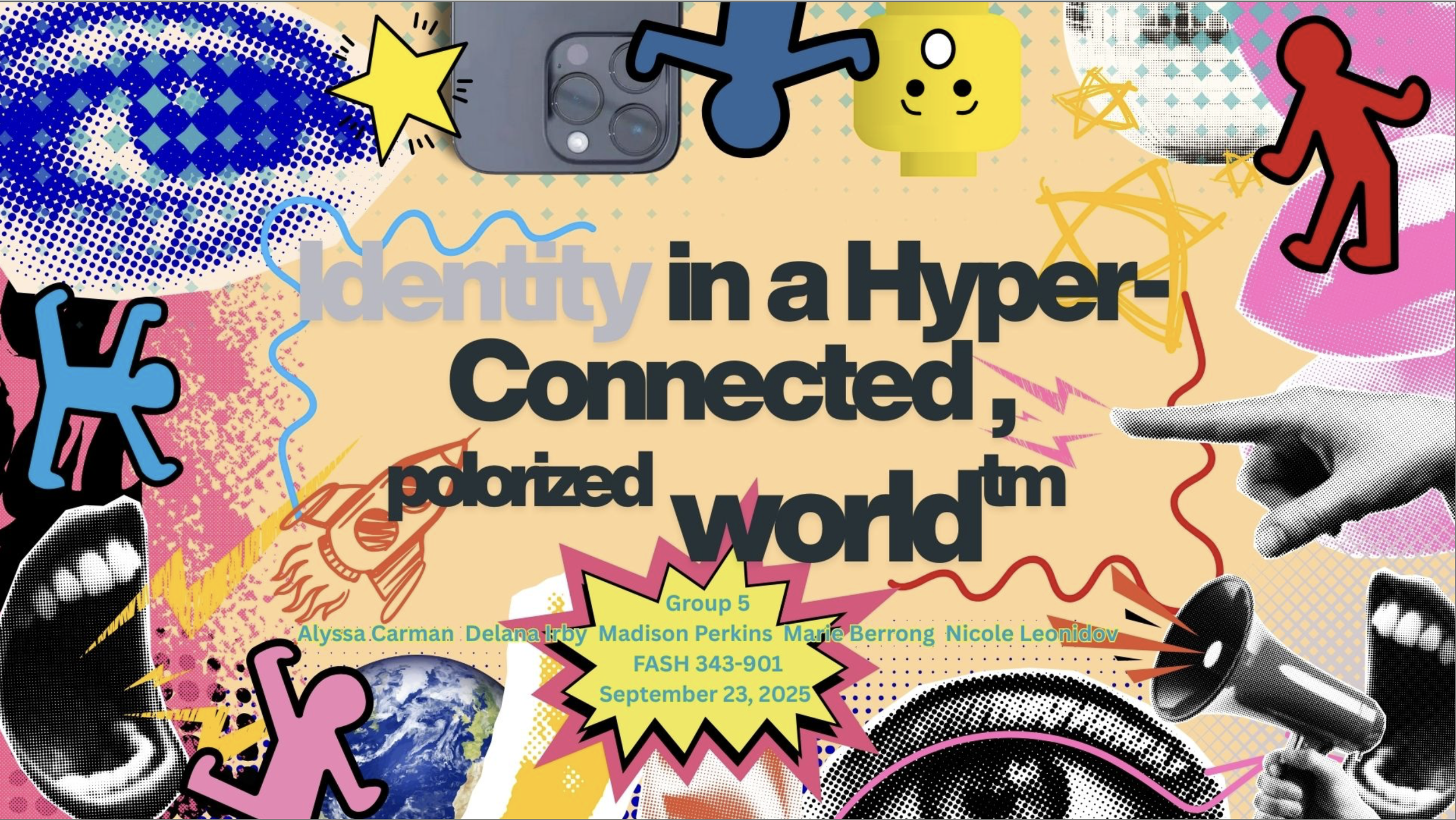
“Identity in a hyper-connected, polrized world”